

Casa Program
Starting at age three, children enter our Casa Program, a three-year Montessori experience designed to foster independence, critical thinking skills, and a curious mind.
Through purposeful choice and meaningful work, children develop focus, social-emotional awareness, and a strong academic foundation that extends well beyond the classroom, shaping confident, capable learners.


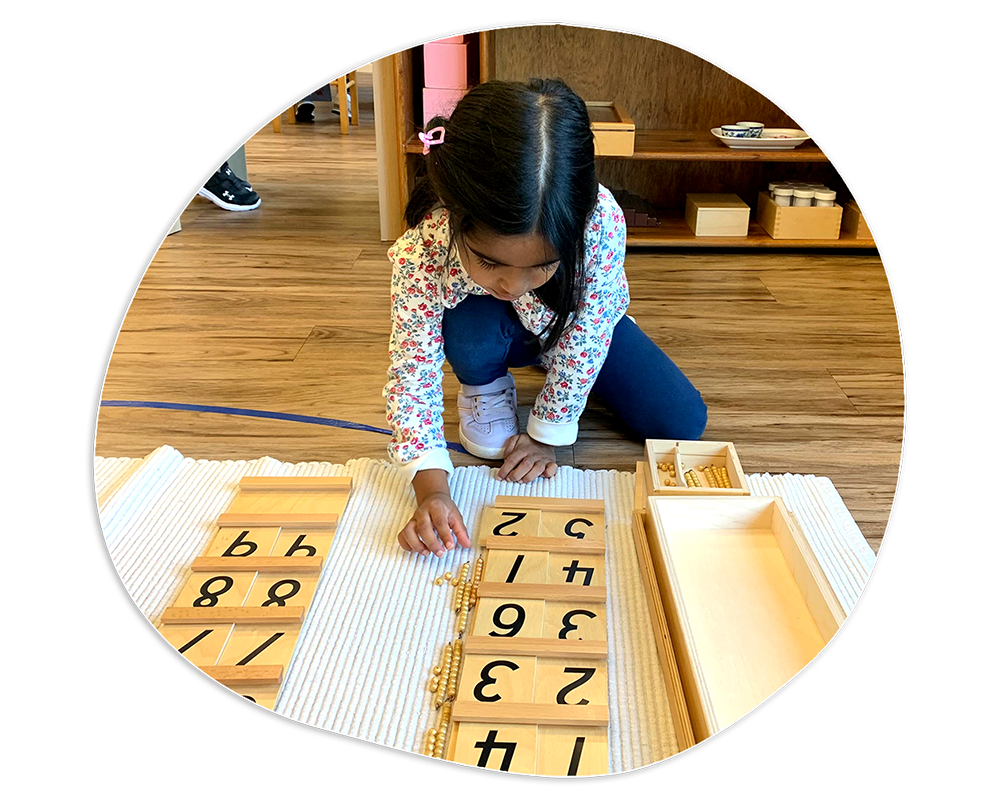


Our comprehensive Casa curriculum
Sensorial
The materials of the Casa Sensorial curriculum are intended to support the child in the development of organized thought patterns, increase critical thinking skills, and enhance focus and concentration. They can be directly linked to the building of foundational Language and Mathematics skills and are also instrumental in furthering the child’s ability to self-correct and apply problem solving skills independently.
The materials of this curriculum offer opportunities for creative experimentation, as well as cooperative work with others, and intentionally incorporate both gross and fine motor movements, supporting the development of spatial awareness as well as physical strength and coordination.
Additionally, through their engagement with the materials of this curriculum, children gain refinement of their senses and learn to order, classify, and make objective discernments about the world around them.

Mathematics
The Casa Mathematics curriculum can be divided into five categories: numbers to ten, the decimal system, teens and tens, the memorization of tables, and the passage to abstraction.
Through their work with the materials from this area, children are introduced to abstract mathematical concepts in a concrete fashion by way of hands-on learning experiences. The exercises of this curriculum are sequential in nature and children must master one concept before being presented with the next.
In addition to introducing numerical concepts such as symbol to quantity correspondence and providing a sensorial impression of addition, multiplication, subtraction, and division, the Mathematics materials also aim to increase order and organization of the mind, improve logical reasoning skills, as well as enhance memory recall and capabilities.

Language
The Casa Language curriculum can be divided into five categories: spoken language, writing, reading, parts of speech, and reading analysis. Through their sequential use of the material from this curriculum, children progress from speaking using enriched vocabulary as well as correct grammar and pronunciation, to spelling and reading with enhanced comprehension. In addition, they advance from forming single letters on a chalkboard to forming words and then sentences on paper, in both cursive and print.
The culmination of an extended vocabulary, refined fine motor movements, phonological awareness, grammatical understanding, and advanced reading capabilities, prepare children for increased success regarding written expression, creative writing, and collaborative project work.
In addition to the English Language curriculum, Casa students are also provided with rotary French class three times a week.

Culture
The Casa Culture curriculum can be divided into six categories: geography, history, biology, zoology, botany, and science.
Engaging with the materials of this curriculum enables children to build a solid understanding of the interactive and interconnected components of the world around them. Through both individual and group lessons, the materials of the Culture curriculum provide opportunities for the enrichment of vocabulary, fulfillment of natural curiosities, increased global awareness and responsibility, as well as appreciation and respect for the world and all living things.
In addition to the multitude of hands-on learning experiences offered through the materials of the Culture curriculum, boundless opportunities are also provided for children to expand on their ever-developing reading, writing, and researching skills.

Practical Life
Divided into the categories of care of self, care of the environment, control of movement, and grace and courtesy, many of the exercises from the Casa Practical Life curriculum are comprised of familiar objects and resemble recognizable household tasks. Although seemingly simple and repetitive, they are highly purposeful and significantly impact the development of important skills such as order, concentration, fine motor control, independence, and social awareness.
Through their work with the Practical Life exercises, children learn to engage with purpose while caring for themselves as well as their environment. They develop a sense of confidence and belonging while making helpful and necessary contributions to the functionality of their classroom communities. They learn to conduct themselves gracefully, while demonstrating respect and compassion for others, ultimately preparing themselves for success in all areas of life.

❤️ from our families
Frequently Asked Questions
Get a better understanding of the Casa program and its various aspects by exploring our FAQ’s. These will provide insight into our programming, the value to your child, and learning objectives of the program.
Still have questions on your mind? We would love to hear from you.
What makes the Montessori Casa classroom unique?
The Casa classroom provides a carefully prepared environment that fosters independence, intellectual curiosity, and a love of learning. Children engage in purposeful, hands-on learning experiences that support the development of academic, social, and emotional skills through progressively challenging work matched to their stage of development. Educators plan and present individualized lessons and guide each child thoughtfully, encouraging concentration, responsibility, confidence, and a strong sense of community.
What are the long-term benefits of a Montessori education?
Montessori education builds a foundation for lifelong success. Children develop independence, problem-solving skills, adaptability, and creativity. Through experiential learning and critical thinking, they become confident, resilient learners who thrive in diverse environments and contribute meaningfully to their communities.
Why is the three-year Casa cycle important?
The three-year cycle is the foundation of authentic Montessori education. It allows children to move through a natural progression of exploration, consolidation, and mastery, nurturing both academic and personal growth.
Year One – Independence: Children learn to care for themselves and their environment. They absorb routines, language, and materials that build concentration and confidence.
Year Two – Competence: Understanding deepens through repetition and collaboration. Children refine their skills, support peers, and internalize the classroom structure.
Year Three – Leadership: The child who once observed now leads. Academic and social mastery blossom as reading, writing, numeracy, and leadership come together.
The three-year Casa program gives children the time and consistency to grow at a natural pace, transforming curiosity into mastery and independence into leadership. Over these years, they build confidence, strengthen understanding, and develop meaningful academic and social skills. This steady progression nurtures emotional security, fosters intellectual growth, and prepares children to thrive as confident, capable learners ready for the next stage of learning.
What is the role of the Casa educator?
Montessori educators act as careful guides, observing each child and introducing lessons when they are ready, while stepping back to allow independent mastery. Their focus is on teaching the child, not the curriculum, recognizing that learning unfolds at an individual pace. Through careful observation and record-keeping, educators tailor lessons to each child’s stage of development, balance freedom with purposeful structure, and encourage curiosity, engagement, and independence. This partnership between the educator, the child, and the environment builds confidence, responsibility, and self-motivation that extends beyond the Casa years.
Open and ongoing communication with families is an essential part of this role. Educators connect regularly with families through phone calls to discuss routines, development, and any questions or concerns. The program also uses Transparent Classroom, an online platform where families can access progress reports that reflect their child’s growth and learning over time.
Are Casa children expected to be independent in self-care, meals, and naps?
In the Casa classroom, children manage their personal care routines independently, including toileting and mealtimes. During snacks and lunch, they practice feeding themselves and table manners, with educators providing guidance as needed. A hot lunch and two nutritious snacks are provided daily by an outside catering company. Quiet rest periods are available for first-year students if needed. Educators work closely with families to support self-care skills, reinforcing independence as a key part of the Montessori curriculum.
How is socialization encouraged in the Casa classroom?
Social skills develop naturally through individual, paired, and small-group experiences. Many materials are designed for cooperative use, promoting turn-taking, teamwork, and collaboration. Circle Time and enrichment classes, such as French, Music, and Yoga, give children additional opportunities to interact, listen, and work together in a larger group. Grace and courtesy lessons teach respectful language, empathy, and awareness of others, supporting positive interactions. Outdoor play is an essential part of the day, allowing children to develop physical coordination, social problem-solving, and cooperative play in a natural setting.
How do Casa students transition to traditional school?
Montessori graduates transition smoothly due to their independence, self-discipline, and strong problem-solving skills. Through active exploration and guided learning, children develop advanced academic skills, conceptual understanding, and a clear sense of how they learn best. Their well-developed curiosity, initiative, and ability to collaborate allow them to adapt confidently to new expectations and environments, thriving both academically and socially.
What is the goal for Casa graduates?
Our goal for each child completing the three-year Casa cycle is to support their growth academically, socially, and emotionally. The program is designed to nurture children as they develop into:
- Independent thinkers who can make choices and follow through with focus and self-motivation
- Confident communicators who express ideas clearly and listen respectfully
- Innovative problem-solvers who approach challenges with patience, creativity, and resilience
- Caring community members who show empathy, fairness, and kindness to others
- Curious learners who ask questions and seek to understand
- Academically prepared individuals, with a strong foundation in reading, writing, and mathematical understanding, for the next stage of learning

York Montessori School
10533 Leslie Street
Richmond Hill, Ontario L4S 1P1
© 2026. All Rights Reserved.

Formerly Canadian Council of Montessori Administrators (CCMA)
